What is an Ecosystem?
Term 1, Week 1, Lesson 2
Do Now
In your book, answer this question in 2–3 sentences:
“Think of a place in nature. What living and non-living things might you find there?”
Choose a place like:
- A beach
- A forest
- A pond
- Your backyard
Daily Review
N/A — This is the first lesson of the Ecosystems topic.
Learning Intentions
Today we are learning about what an ecosystem is and the relationships that exist within ecosystems.
Success Criteria
You will be successful if you have:
Keywords
- Ecosystem
- A community of living organisms interacting with each other and their non-living environment.
- Habitat
- The natural home or environment of an organism.
- Community
- All the populations of different species living together in an area.
- Population
- A group of organisms of the same species living in the same area.
- Organism
- Any living thing.
Learning Activities
Activity 1 — I DO: What is an Ecosystem?
An ecosystem is one of the most important concepts in biology. Let’s explore what it means.
Definition of an Ecosystem
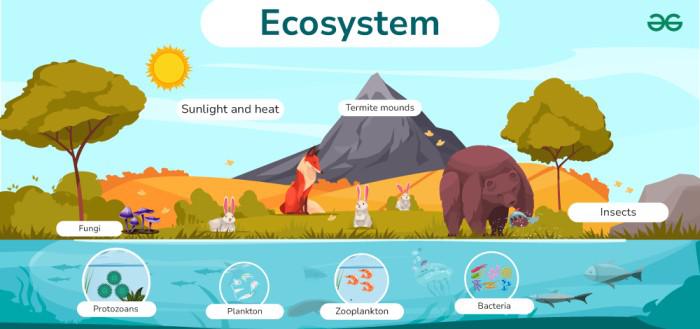
An ecosystem is a community of living organisms interacting with each other and their non-living environment.
The word “ecosystem” comes from two parts:
- Eco = home or environment
- System = a set of connected things working together
Examples of Ecosystems
Ecosystems can be large or small:
| Ecosystem | Examples of Living Things | Examples of Non-Living Things |
|---|---|---|
| Rainforest | Trees, monkeys, insects, birds, fungi | Soil, water, sunlight, rocks |
| Ocean | Fish, whales, seaweed, coral, plankton | Salt water, sand, temperature, currents |
| Desert | Cacti, lizards, snakes, scorpions | Sand, rocks, heat, limited water |
| Pond | Frogs, fish, algae, water plants, insects | Water, mud, sunlight, temperature |
| Your backyard | Grass, insects, birds, worms, bacteria | Soil, water, air, rocks |
Relationships in Ecosystems
Everything in an ecosystem is connected:
- Animals eat plants
- Animals eat other animals
- Dead organisms decompose and return nutrients to the soil
- Plants use nutrients from the soil to grow
Key idea: If one part of an ecosystem changes, it can affect many other parts.
Check for Understanding
Think about this: What might happen to a pond ecosystem if all the frogs disappeared?
Answer: Insect populations might increase (since frogs eat insects), which could affect plants. Fish and birds that eat frogs would need to find other food sources.
Activity 2 — WE DO: Exploring a Local Ecosystem
As a class, we will identify the living and non-living components of a local ecosystem.
Our Local Ecosystem: The School Oval / Nearby Bushland
Discussion questions:
- What living things can we find here?
- Plants: _______________
- Animals: _______________
- Microorganisms: _______________
- What non-living things are present?
- How are these things connected?
- What eats what?
- What provides shelter for what?
- What depends on what?
Class Ecosystem Map
Together, we will create a simple diagram showing the connections in our local ecosystem.
Activity 3 — YOU DO: Design Your Own Ecosystem
Complete the worksheet: 111-what-is-an-ecosystem-you-do.docx
You will:
- Choose an ecosystem to draw and label
- Identify at least 5 living things and 5 non-living things
- Show the connections between them
Work independently. You have 12 minutes to complete the worksheet.
Notes
Use this space to write any important points from today’s lesson.
Reflection
Exit Ticket
On a piece of paper or in your book, write:
Your own definition of an ecosystem in ONE sentence.
Your definition should:
- Be in your own words (not copied from the board)
- Include both living and non-living things
- Mention that things interact or are connected
Hand this in before you leave.
Home-study
Go outside at home (backyard, park, or any natural area). List 5 living things and 5 non-living things you can see. Bring your list to the next lesson.