Types of Adaptations
Term 1, Week 3, Lesson 2
Do Now
In your book, answer these questions:
- Write down your definition of an adaptation from last lesson.
- Predict: What are three different ways an organism could be adapted to its environment?
You have 3 minutes.
Daily Review
Answer the following 5 multiple choice questions in your book:
- An adaptation is best described as:
- A temporary change in an organism
- An inherited trait that helps an organism survive and reproduce
- Any behaviour an animal performs
- A feature that makes an organism look different
- Which of the following is an example of an adaptation?
- A dog learning to shake hands
- A person getting a sunburn
- A banksia’s woody follicles opening after fire
- A broken wing on a bird
- Adaptations develop through:
- Individual effort during an organism’s lifetime
- Natural selection over many generations
- Random chance in a single generation
- Training by parent organisms
- The dugong’s streamlined body is an adaptation because it:
- Makes the dugong look attractive
- Helps it move efficiently through water to reach seagrass
- Protects it from sunburn
- Was learned from other dugongs
- Which of the following is NOT an adaptation?
- A thorny devil’s spiny skin
- A boab tree’s swollen trunk
- A scar on a kangaroo’s leg
- A bilby’s large ears
Learning Intentions
Today we are learning about the three types of adaptations — structural, behavioural, and physiological — and how to classify examples of each.
Success Criteria
You will be successful if you have:
Keywords
- Structural adaptation
- A physical feature of an organism’s body that helps it survive in its environment. Examples include body shape, colour, and protective coverings.
- Behavioural adaptation
- An action or pattern of behaviour that an organism performs to increase its chances of survival. Examples include migration, nocturnal activity, and hibernation.
- Physiological adaptation
- An internal body process or function that helps an organism survive. Examples include the ability to produce venom, regulate body temperature, or produce concentrated urine.
Learning Activities
Activity 1 — I DO: The Three Types of Adaptations
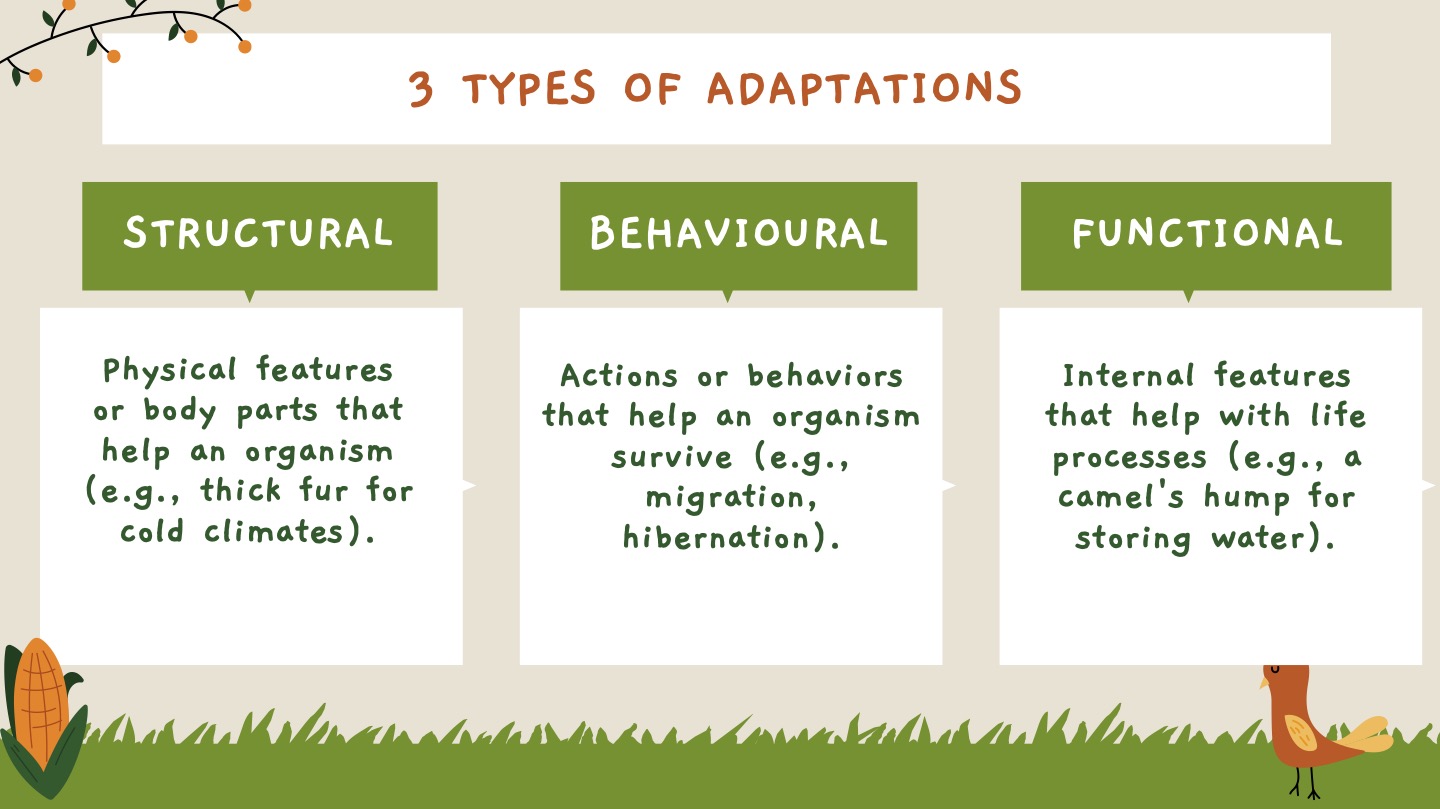
All adaptations can be grouped into three categories: structural, behavioural, and physiological. Understanding these categories helps us describe and compare how different organisms are suited to their environments.
Structural Adaptations
Structural adaptations are physical features of an organism’s body. You can usually see a structural adaptation by looking at the organism.
| Organism | Structural Adaptation | How It Helps |
|---|---|---|
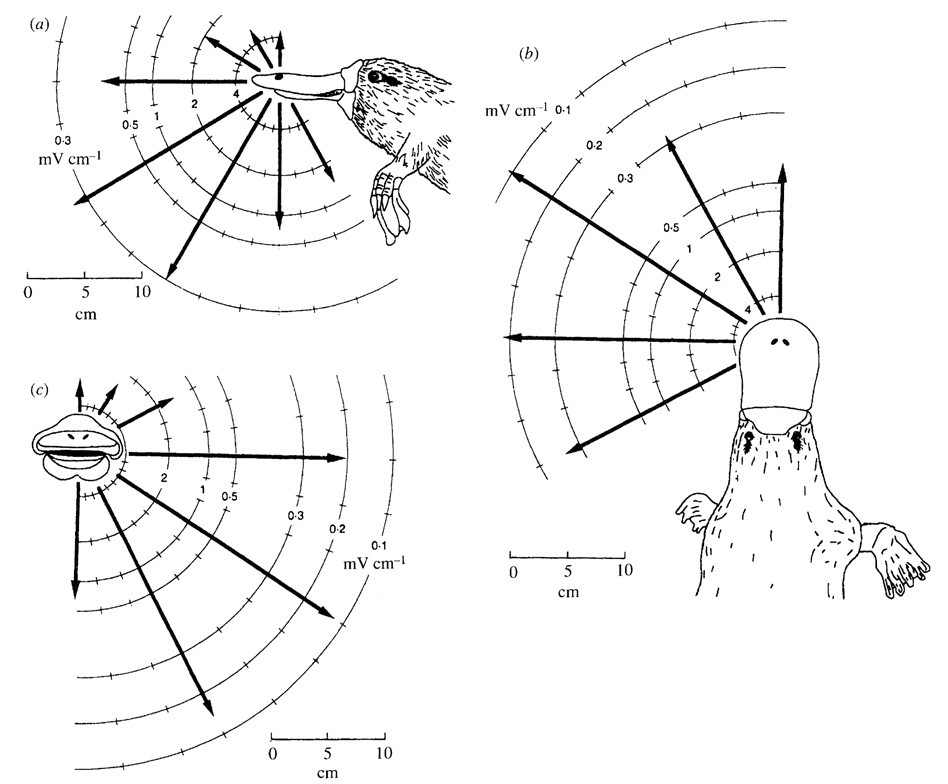
| Platypus | Electro-sensitive bill | Detects electrical signals from prey in murky water |
| Jarrah tree | Thick, rough bark | Protects the trunk from damage during bushfires |
| Thorny devil | Spiny body with grooved scales | Spines deter predators; grooves channel water to the mouth |
| Wedge-tailed eagle | Large wingspan (up to 2.3 m) | Soars on thermal currents to scan large areas for prey |
| Wattle (Acacia) | Flattened leaf stalks (phyllodes) instead of true leaves | Reduces water loss while still performing photosynthesis |
Behavioural Adaptations
Behavioural adaptations are actions an organism performs to survive. These are things an organism does, not what it looks like.
| Organism | Behavioural Adaptation | How It Helps |
|---|---|---|
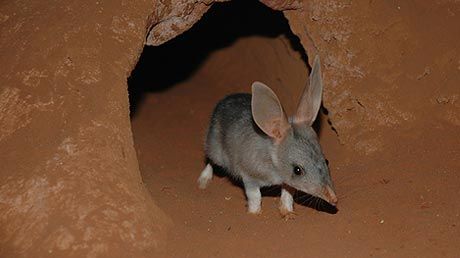
| Bilby | Nocturnal (active at night) | Avoids extreme daytime desert heat |
| Humpback whale | Annual migration along the WA coast | Travels to warm tropical waters to breed and calve |
| Honey possum | Follows flowering seasons of banksia and other plants | Ensures a continuous food supply of nectar and pollen |
| Thorny devil | Rocks back and forth while walking | Confuses predators, making it harder to catch |
| Bowerbird | Builds and decorates elaborate bowers | Attracts mates for reproduction |
Physiological Adaptations
Physiological adaptations are internal body processes. You usually cannot see a physiological adaptation just by looking at the organism — it happens inside the body.
| Organism | Physiological Adaptation | How It Helps |
|---|---|---|
| Red kangaroo | Produces highly concentrated urine | Conserves water in arid environments |
| Western brown snake | Produces potent venom | Subdues prey quickly and efficiently |
| Eucalyptus | Produces toxic oils in leaves | Deters most herbivores from eating the leaves |
| Spinifex grass | Tolerates extremely low soil nutrients | Survives in poor desert soils where other plants cannot |
| Saltbush | Accumulates salt in special bladder cells on leaves | Tolerates high-salinity soils in arid areas |

Can Adaptations Fit More Than One Category?
Sometimes an adaptation could be classified in more than one way. For example: a thorny devil collecting water through its skin grooves involves both a structural feature (the grooves) and a physiological process (capillary action moving the water).
The key is to understand the mechanism — is it about the body’s physical shape, an action the organism performs, or an internal process?
Check for Understanding
Quick check: Hold up your card — S (structural), B (behavioural), or P (physiological):
- A kangaroo’s strong hind legs → ___
- A bilby sleeping during the day → ___
- A snake producing venom → ___
- A bird migrating south for winter → ___
- A cactus with a thick, waxy stem → ___
Answers: 1. S, 2. B, 3. P, 4. B, 5. S
Activity 2 — WE DO: Adaptation Card Sort
In pairs, you will receive a set of 12 adaptation cards. Sort each card into the correct category.
Record your answers in the table below:
| # | Adaptation | Structural | Behavioural | Physiological | Justification |
|---|---|---|---|---|---|
| 1 | Echidna curls into a ball when threatened | ||||
| 2 | Boab tree stores water in its trunk | ||||
| 3 | Quokka is active mainly at night | ||||
| 4 | Eucalyptus produces toxic oils | ||||
| 5 | Emu has strong legs for running | ||||
| 6 | Saltwater crocodile lies still to ambush prey | ||||
| 7 | Kangaroo paw has furry covering on flowers | ||||
| 8 | Dolphin uses echolocation | ||||
| 9 | Frill-necked lizard spreads its frill | ||||
| 10 | Banksia has proteoid roots for nutrient uptake | ||||
| 11 | Kookaburra calls at dawn to defend territory | ||||
| 12 | Desert frog stores water in its bladder |
Class Discussion
- Which cards caused disagreement in your pair? Why?
- Were there any adaptations that could fit into more than one category?
- How did you decide which category was the best fit?
Activity 3 — YOU DO: Classifying Adaptations
Complete the worksheet: 132-types-of-adaptations-you-do.docx
You will classify a new set of adaptations, identify the category, and write a brief justification for each.
Work independently. You have 10 minutes to complete the worksheet.
Notes
Use this space to write any important points from today’s lesson.
Reflection
A physical feature of an organism that helps it survive is called a:
- Behavioural adaptation
- Structural adaptation
- Physiological adaptation
- Learned behaviour
A bilby being active at night is an example of which type of adaptation?
- Structural
- Physiological
- Behavioural
- None of the above
Which of the following is a physiological adaptation?
- A bird building a nest
- A lizard with camouflage colouring
- A snake producing venom
- An emu running from a predator
A student says: “A kangaroo’s strong legs are a behavioural adaptation because it uses them to hop.” Is the student correct? Explain your reasoning.
Compare structural and physiological adaptations. How are they different? Give one example of each.
Home-study
Choose an Australian organism and identify one adaptation of each type (structural, behavioural, physiological). For each, write one sentence explaining how it helps the organism survive.