How Ectotherms Regulate Temperature
Term 1, Week 5, Lesson 4
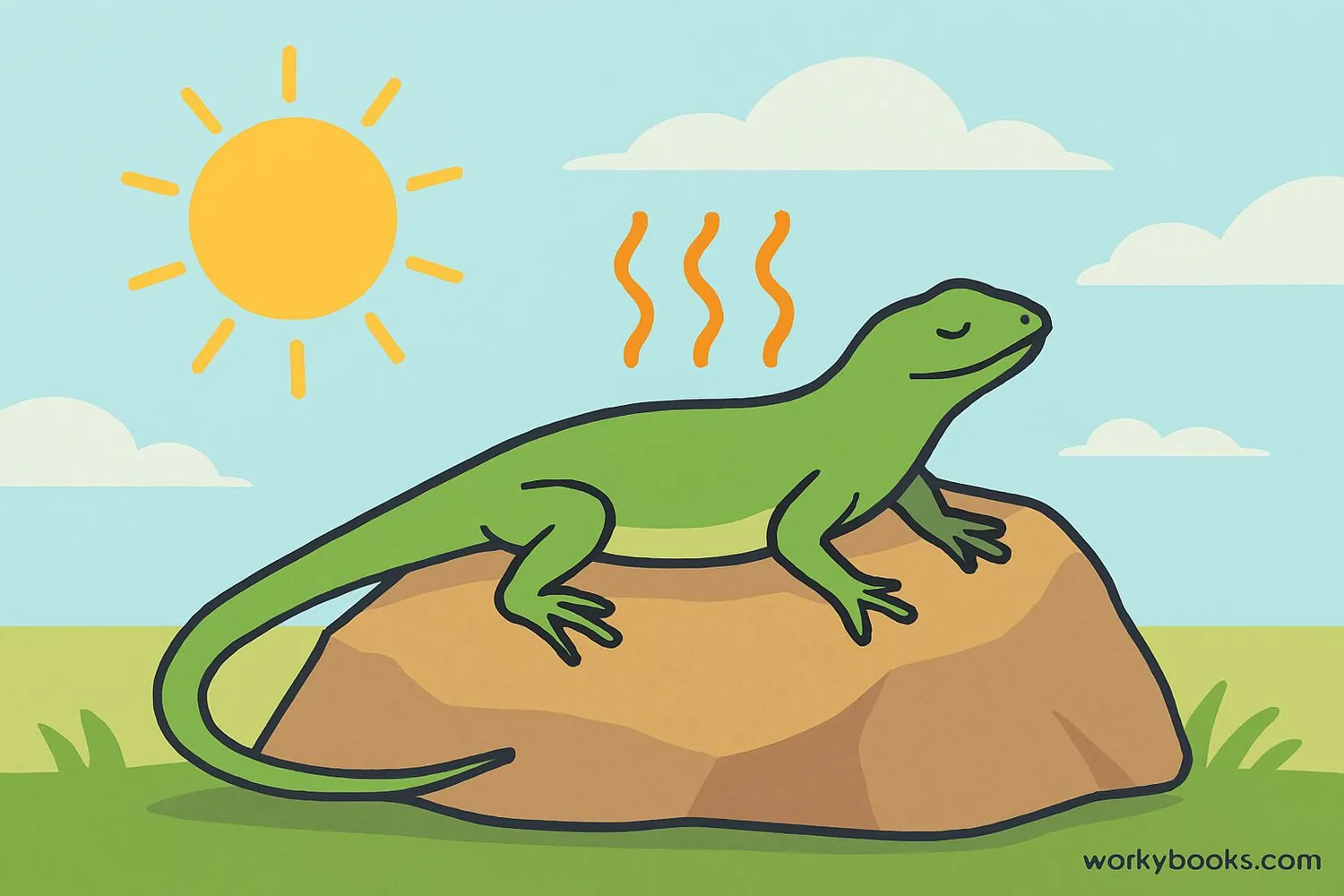
Do Now
Look at the time-lapse sequence below showing a bobtail lizard’s behaviour over one morning in a Perth backyard.
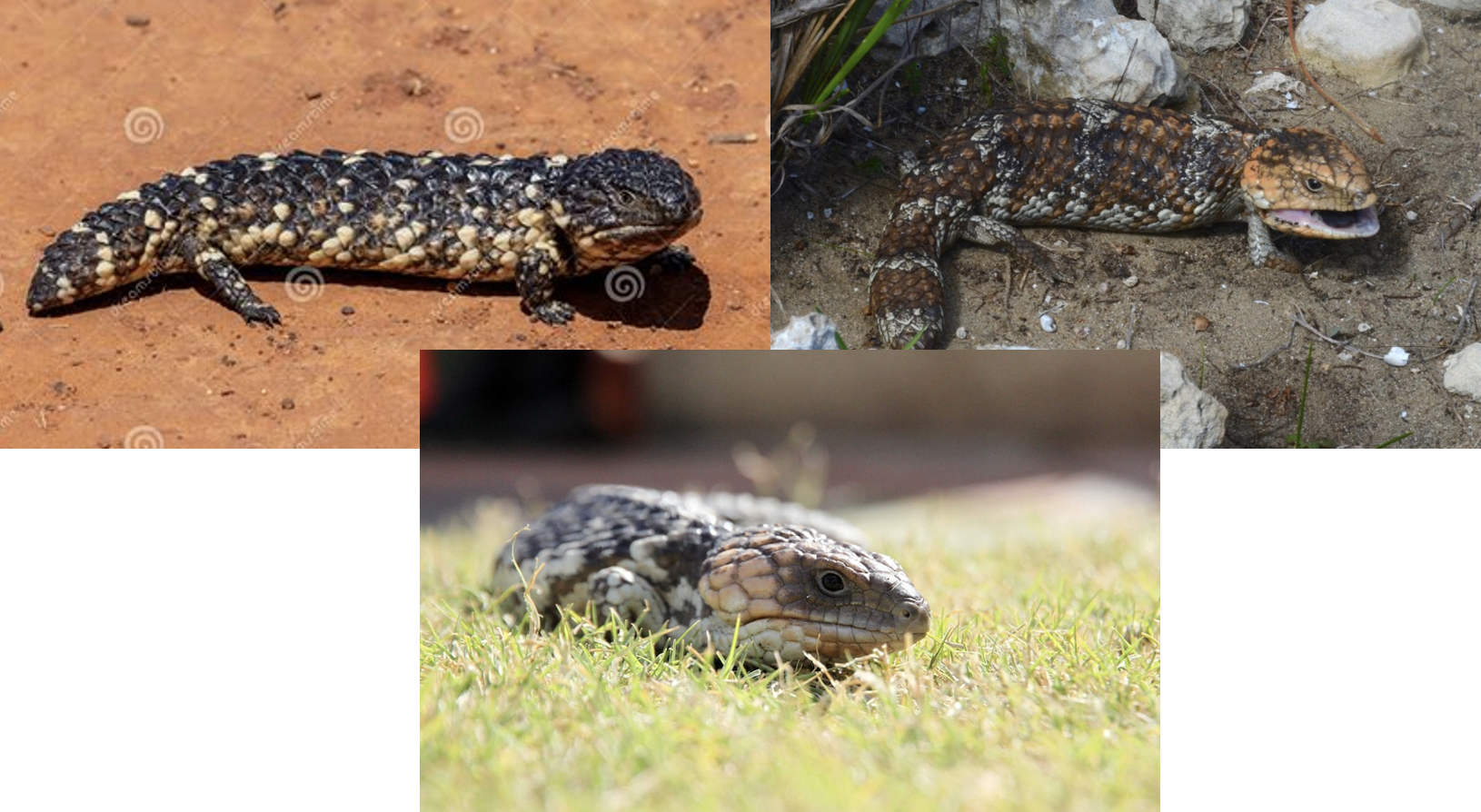
In your book, answer the following:
- What pattern do you notice in the bobtail’s behaviour across the morning?
- Why do you think it moves between the sun and shade rather than staying in one place?
- What do you predict it would do at 2:00 pm on a 42°C summer afternoon?
You have 3 minutes.
Daily Review
Answer the following 5 multiple choice questions in your book:
- Vasodilation helps an endotherm cool down by:
- Reducing blood flow to the skin to conserve heat
- Widening blood vessels near the skin, increasing heat loss by radiation
- Causing rapid involuntary muscle contractions
- Producing sweat on the skin surface
- Shivering is classified as which type of response in an endotherm?
- A structural adaptation
- A physiological response
- A behavioural response
- An ecological adaptation
- Negative feedback works by:
- Amplifying a change away from the set point
- Allowing body temperature to keep rising indefinitely once started
- Producing a response that opposes the change and returns the body to its set point
- Increasing the sensitivity of receptors to stronger stimuli
- The echidna is notable among WA endotherms because:
- It generates heat through countercurrent exchange only
- It has no sweat glands and relies entirely on behavioural thermoregulation
- It uses piloerection to cool down in summer
- It can lower its metabolic rate to match an ectotherm
- Piloerection helps an endotherm warm up by:
- Increasing blood flow to the extremities
- Causing muscles to contract rapidly and generate heat
- Trapping a layer of warm air next to the skin
- Reducing heat production through slower metabolism
- B 2) B 3) C 4) B 5) C
Learning Intentions
Today we are learning how ectotherms use behavioural strategies and some physiological responses — including basking, burrowing, shuttling and body orientation, and metabolic heat and colour change — to regulate their body temperature without generating significant internal heat.
Success Criteria
You will be successful if you have:
Keywords
- Preferred body temperature (PBT)
- The temperature range at which an ectotherm’s enzymes function most efficiently and the animal is most active. Ectotherms actively seek this temperature using behaviour. Different species have different PBTs — for example, many WA lizards have a PBT of 30–38°C.
- Basking
- Positioning the body in direct sunlight or on a warm surface to absorb solar (radiant) heat and raise body temperature.
- Shuttling
- Moving repeatedly between areas of sun and shade to maintain body temperature within the preferred body temperature range, preventing overheating or undercooling.
- Thermoconformer
- An ectotherm that allows its body temperature to closely follow environmental temperature, making little active effort to regulate it. Most aquatic invertebrates are thermoconformers. (Contrasted with thermoregulators, which actively move to manage their temperature.)
- Physiological colour change
- The ability of some reptiles to adjust the darkness of their skin pigmentation — darkening in the morning to absorb more solar radiation, then lightening as body temperature rises to reduce heat absorption.
Learning Activities
Activity 1 — I DO: How Ectotherms Manage Without Internal Heat
The Challenge for Ectotherms
Without the ability to generate significant internal heat, ectotherms must be strategic about their behaviour. Their goal is to reach and stay within their preferred body temperature (PBT) — the range where their enzymes work most efficiently and they can move, digest, and reproduce effectively.
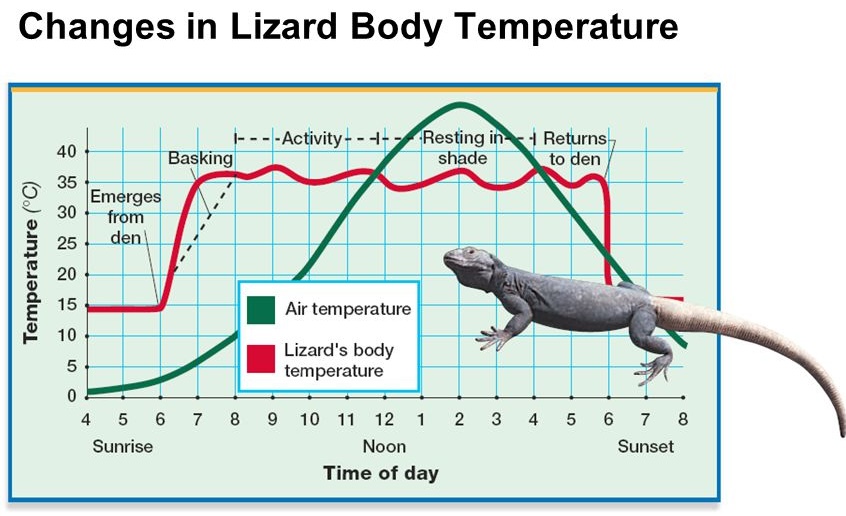
The graph above shows a typical daily pattern for a WA lizard. Notice:
- Early morning: body temperature is low → the lizard must bask before it can be fully active.
- Mid-morning to early afternoon: body temperature is within PBT → peak activity.
- Peak afternoon heat: the lizard must retreat to avoid overheating.
- Evening: body temperature drops again → activity ceases.
Behavioural Thermoregulation Strategies
1. Basking
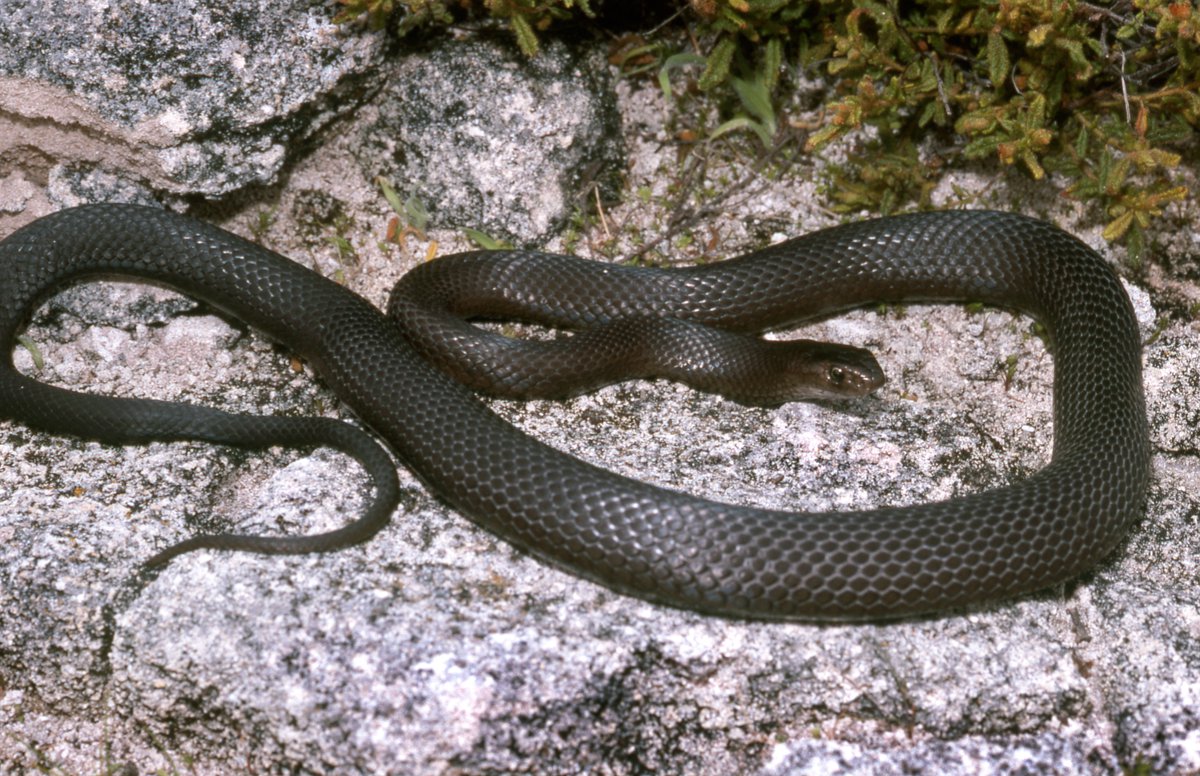
- The ectotherm positions its body in direct sunlight or on a warm surface (warm rock, road, sand) to absorb solar radiation and conduction from the warm substrate.
- WA example: Dugite snakes (Pseudonaja affinis) are commonly seen on warm road surfaces at dawn — the bitumen, which has retained heat overnight, conducts warmth directly into the snake’s body.
2. Shuttling (Sun–Shade Alternation)
- The ectotherm moves repeatedly between patches of sun and shade to prevent overheating, maintaining temperature within the PBT range.
- WA example: The bobtail lizard (Tiliqua rugosa), familiar to most Perth residents, shuttles continuously between sunny and shaded spots in gardens and bushland throughout the morning.
3. Burrowing (Thermal Refuge)
- Underground temperatures are significantly more stable and cooler than the surface during peak summer heat. When surface temperatures exceed the PBT, the ectotherm retreats underground.
- WA example: Dugite snakes and western bearded dragons retreat under rocks, logs or into soil burrows during the hottest part of the day.
4. Body Orientation
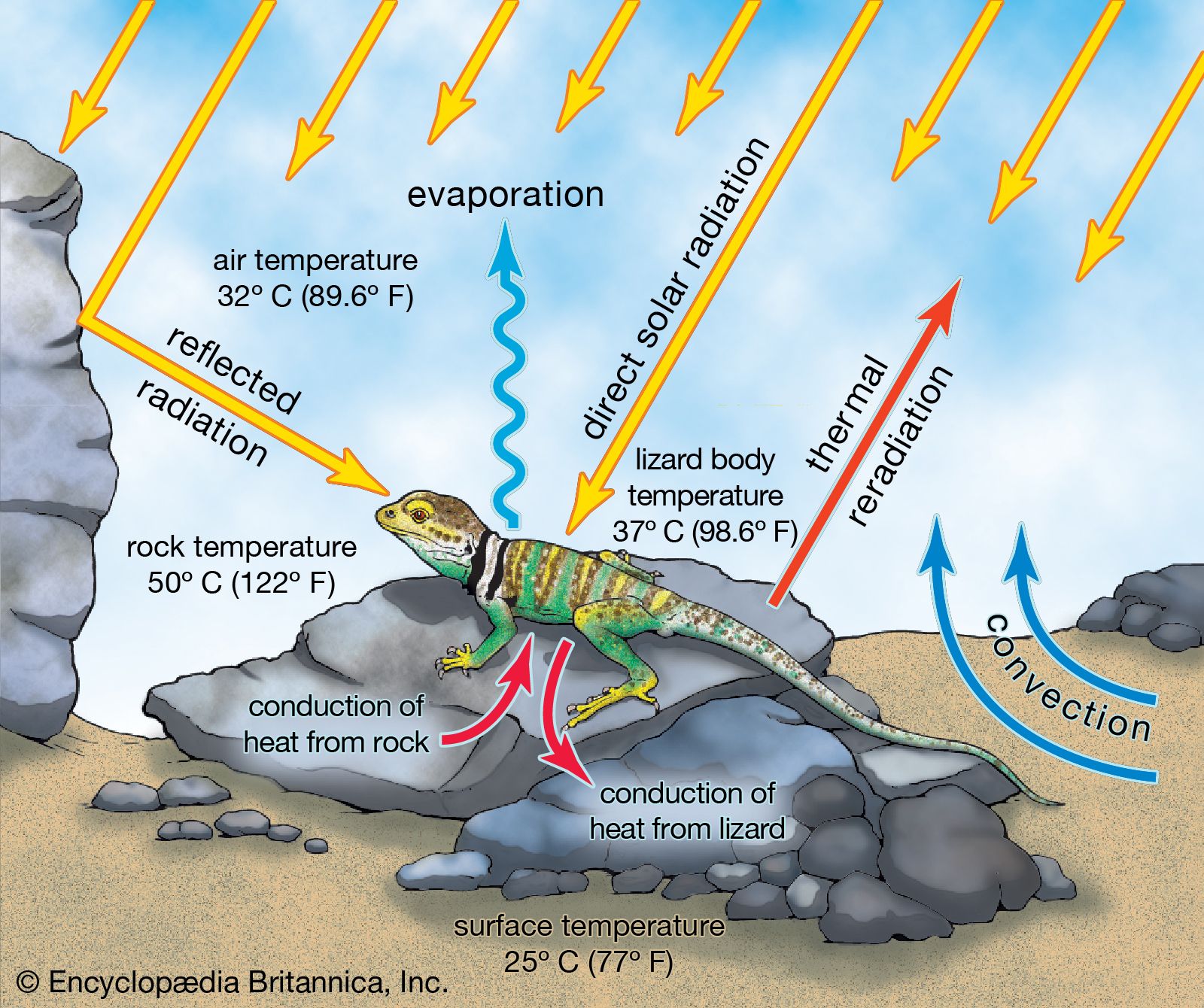
- Morning (cool): The ectotherm orients its body perpendicular (at 90°) to the sun’s rays → maximum surface area is exposed → maximum solar radiation absorbed.
- Midday (hot): The ectotherm orients its body parallel to the sun’s rays → minimum surface area is exposed → reduces heat gain.
- WA example: Western bearded dragons (Pogona minor) and thorny devils (Moloch horridus) are regularly observed using this strategy.
5. Climbing to Elevated Positions
- Climbing onto elevated rocks or branches exposes the animal to breezes (convective cooling) and positions them in areas with different thermal properties.
- WA example: Western bearded dragons frequently bask on elevated fence posts and rocks in semi-arid WA.
Physiological Colour Change
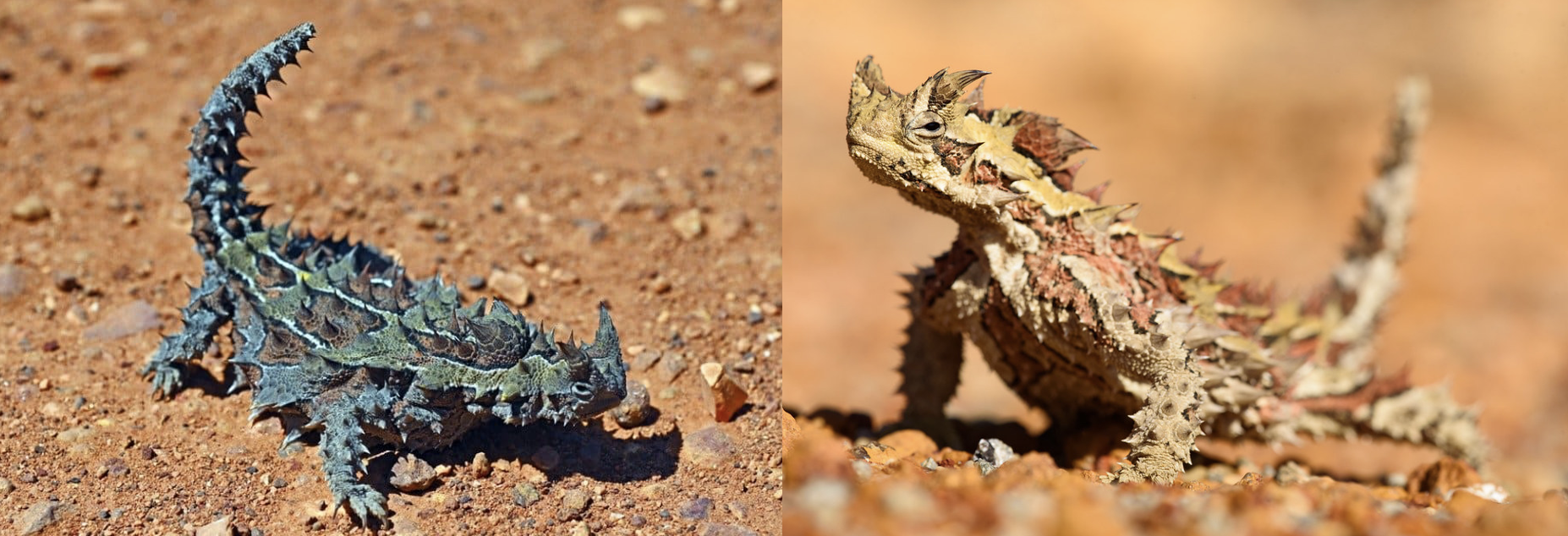
Some WA reptiles can adjust their skin pigmentation using pigment-containing cells called chromatophores:
- Morning (cool): Skin darkens → absorbs more solar radiation → warms faster.
- Afternoon (hot): Skin lightens → reflects more solar radiation → reduces heat gain.
WA examples: Thorny devil (Moloch horridus), western bearded dragon (Pogona minor).
Type of adaptation: Physiological (and structural — the chromatophores themselves are structural)
Comparing Ectotherm and Endotherm Thermoregulation in the Same Ecosystem
Both the thorny devil (ectotherm) and the bilby (endotherm) live in the arid WA desert. How do their thermoregulation strategies compare?
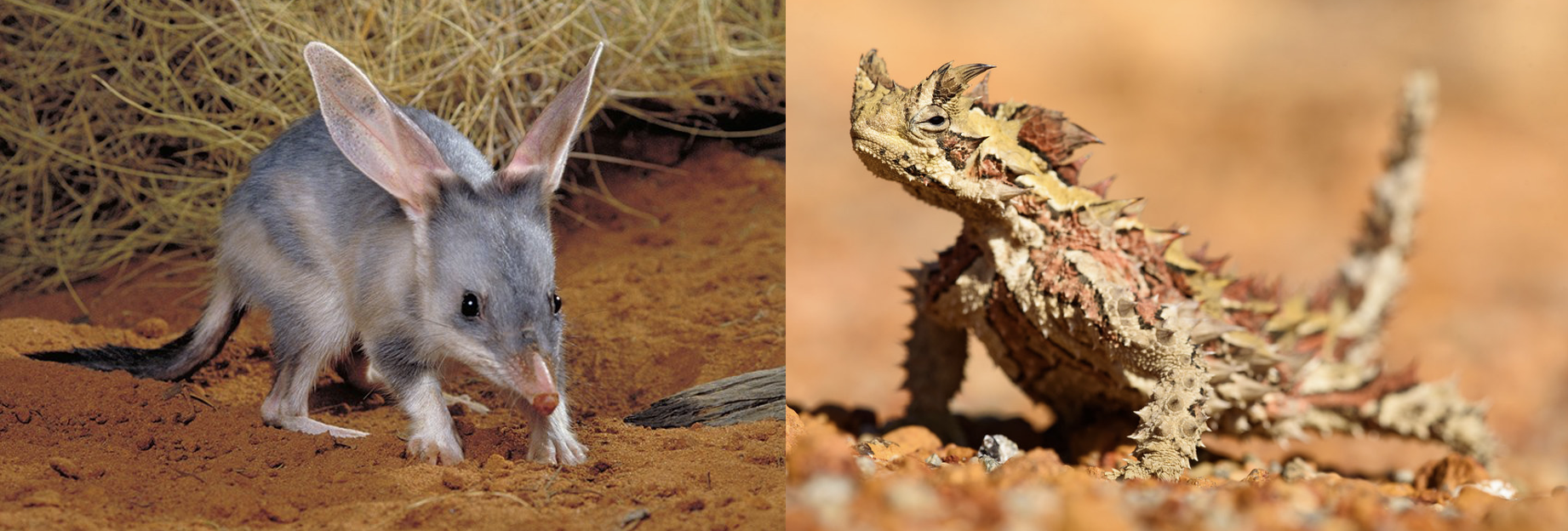
| Thorny Devil (Ectotherm) | Bilby (Endotherm) | |
|---|---|---|
| Heat source | External (sun, ground) | Internal (metabolism) |
| Active period | Mid-morning to early afternoon | Night (nocturnal) |
| Main cooling strategy | Burrowing; body orientation to minimise sun exposure | Panting; burrowing; licking paws |
| Main warming strategy | Basking; body orientation to maximise sun exposure | Shivering; vasoconstriction; huddling |
| Type of responses | Mostly behavioural (+ physiological colour change) | Mostly physiological (+ behavioural) |
Key similarity: Both rely on burrowing to avoid extreme temperatures — the bilby uses it to avoid daytime heat, and the thorny devil uses it to escape the hottest hours.
Climate Change and WA Ectotherms
As WA’s summers become hotter and heat events more frequent, ectotherms face a narrowing thermal activity window — the time of day when conditions allow safe activity. Research suggests that WA reptile populations in some areas are spending more time in shelter and less time foraging, which reduces their ability to find food and reproduce.
Check for Understanding
Quick questions: Answer in your book.
- A dugite snake is found on a warm road at 6:30 am. Is this basking, shuttling, or burrowing? What is the snake trying to achieve?
- At midday on a 44°C day, the same snake is nowhere to be seen. Where is it most likely to be? Why?
- Why would a thorny devil have darker skin at 7:00 am but lighter skin at 1:00 pm?
Answers: 1) Basking — absorbing conductive heat from the warm road to raise body temperature toward PBT. 2) In a burrow or under a rock — where temperature is stable and cooler than the 44°C surface. 3) Darker skin absorbs more solar radiation in the cool morning to warm faster; lighter skin reflects more radiation in the hot afternoon to avoid overheating.
Activity 2 — WE DO: Analysing Ectotherm Thermoregulation Data

The table above shows measurements taken of a dugite snake in the Kimberley over a single 24-hour period in February. For each time point, the researcher recorded: air temperature, the snake’s body temperature, and its behaviour (basking, shuttling, in shelter, inactive).
Guided Analysis Questions
Answer the following questions using the data table:
At what time of day was the snake’s body temperature closest to its PBT of 30–35°C? What was it doing at this time?
Between 12:00 pm and 3:00 pm, the air temperature reached 44°C. What behaviour was recorded, and what does this tell you about the snake’s PBT?
Describe the relationship between air temperature and the snake’s body temperature between 6:00 am and 10:00 am.
At midnight, the air temperature was 28°C. Why was the snake inactive even though this is within its PBT range?
How does the snake’s thermoregulation strategy differ from what a bilby would do on the same day in the same environment?
Activity 3 — YOU DO: Ectotherm Thermoregulation

Complete the worksheet: 154-how-ectotherms-regulate-temperature-you-do.docx
You will compare the thermoregulation strategies of a WA ectotherm and a WA endotherm from the same ecosystem, classifying each response as behavioural or physiological.
Work independently. You have 10 minutes.
Notes
Use this space to write any important points from today’s lesson.
Reflection
- The preferred body temperature (PBT) is the temperature at which:
- An ectotherm feels most comfortable according to instinct
- An ectotherm’s enzymes function most efficiently
- An endotherm’s blood vessels begin to dilate
- An ectotherm can survive the coldest conditions
- Shuttling is best described as:
- Retreating underground to avoid peak surface heat
- Moving repeatedly between sunny and shaded areas to maintain a stable body temperature
- Aligning the body perpendicular to the sun in the morning
- Darkening skin pigmentation to absorb more solar radiation
- A thorny devil orienting its body perpendicular to the sun’s rays at dawn is doing so to:
- Signal to other thorny devils
- Minimise the surface area exposed to solar radiation
- Maximise the surface area exposed to solar radiation and warm up quickly
- Avoid predators by flattening against the ground
- Which WA ectotherm is well-known to Perth residents for shuttling between sun and shade in suburban backyards?
- Dugite snake
- Western bearded dragon
- Bobtail (shingleback) lizard
- Freshwater marron
- Short answer: Explain why a dugite snake is more likely to be found on a warm road surface at dawn than at noon on a 42°C summer day. Use the term preferred body temperature in your answer.
Home-study
Research one impact of climate change on a WA reptile species. Describe how rising temperatures are affecting the animal’s thermoregulation, and explain what this means for its survival. Write 4–5 sentences.