Plant Tropisms: Phototropism and Geotropism
Term 1, Week 6, Lesson 2
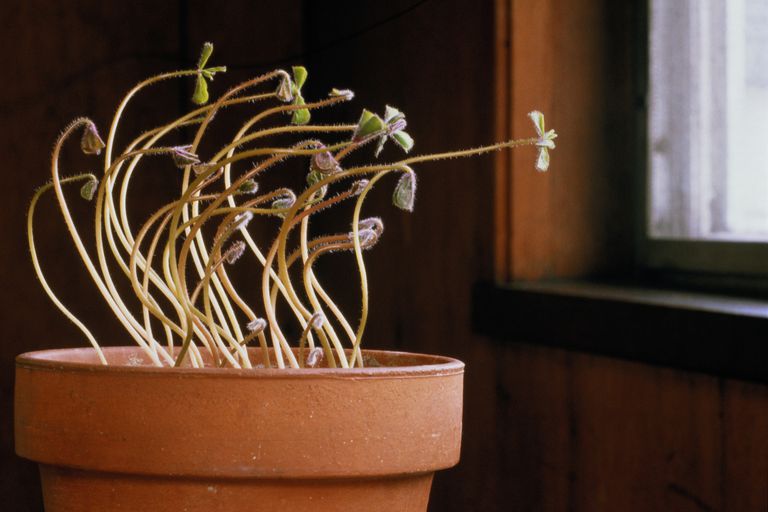
Do Now
Look at the photograph of a pot plant that has been sitting on a windowsill for two weeks.
- What do you notice about the direction the shoot is growing?
- Write a hypothesis: what do you think caused the shoot to grow in this direction?
- If you turned the pot around so the plant faced away from the window, what do you predict would happen over the next two weeks?
You have 3 minutes.
Daily Review
Answer the following 5 multiple choice questions in your book:
- Which heat transfer mechanism involves the movement of heat through moving air or water?
- Conduction
- Convection
- Radiation
- Evaporation
- A dugite snake basks in the morning sunlight to warm up. Which heat transfer mechanism is primarily responsible?
- Conduction
- Convection
- Radiation
- Evaporation
- An endotherm in a cold environment would most likely use which mechanism to reduce heat loss?
- Increasing evaporation from skin
- Pressing against cold rocks
- Trapping still air with dense fur or feathers (insulation)
- Spreading limbs wide to increase surface area
- Evaporation is an especially effective cooling mechanism because:
- It reflects solar radiation away from the skin
- It requires direct contact with a cold surface
- A large amount of heat energy is removed for every gram of water that evaporates
- It only works at night when convective cooling is reduced
- Which of the following best explains why a bobtail lizard is sluggish in the morning but active by 10 am on a summer day?
- It sleeps at night and takes time to wake up
- Its body temperature rises through conduction and radiation as the environment warms
- Its internal metabolic heat generation is highest in the morning
- It needs to eat breakfast before becoming active
- B 2) C 3) C 4) C 5) B
Learning Intentions
Today we are learning to:
- define the term tropism and explain the difference between positive and negative tropisms, and
- explain how the hormone auxin drives phototropism and geotropism in plant shoots and roots.
Success Criteria
You will be successful if you have:
Keywords
- Tropism
- A directional growth response in a plant, in which the direction of growth is determined by the direction of the stimulus. A positive tropism grows toward the stimulus; a negative tropism grows away from it.
- Auxin (IAA)
- What it is: Indole-3-acetic acid — a plant growth hormone produced at the tip of growing shoots (the apical meristem). What it does: promotes cell elongation in shoots at normal concentrations; inhibits cell elongation in roots at those same concentrations. How it moves: transported away from light, and downward in response to gravity.
- Phototropism
- What changes: growth direction in response to light. Positive phototropism: shoot grows toward the light source (most shoots). Negative phototropism: growth away from light (most roots). Mediated by redistribution of auxin to the shaded side.
- Geotropism (gravitropism)
- What changes: growth direction in response to gravity. Positive geotropism: growth in the direction of gravity — roots grow downward. Negative geotropism: growth against gravity — shoots grow upward. Both are mediated by auxin accumulating on the lower side of the organ.
Learning Activities
Activity 1 — I DO: Auxin and Directional Growth
What Is a Tropism?
Plants cannot move from place to place, but they can grow toward or away from stimuli. A tropism is a growth response in which the direction of growth is controlled by the direction of the stimulus. Because growth is irreversible, tropisms produce permanent bends in plant organs.
- Positive tropism — growth toward the stimulus (e.g. shoots growing toward light)
- Negative tropism — growth away from the stimulus (e.g. roots growing away from light)
The Role of Auxin
The key player in most plant tropisms is the hormone auxin (IAA — indole-3-acetic acid), produced at the tip of growing shoots.
Effect on cells:
- In shoots, auxin promotes cell elongation — cells with more auxin get bigger.
- In roots, auxin inhibits cell elongation at the same concentrations — the same amount of auxin that helps shoot cells grow actually suppresses root cell growth.
This difference between how shoot cells and root cells respond to auxin is what allows a single hormone to produce opposite tropisms in roots and shoots.
Phototropism — Response to Light

Step-by-step mechanism:
- Light strikes the shoot from one side (unilateral light).
- Auxin, produced at the shoot tip, migrates away from the light — it accumulates on the shaded side.
- The shaded side of the shoot now has more auxin → more cell elongation → cells on the shaded side grow longer.
- The lit side has less auxin → less elongation → cells on the lit side stay shorter.
- Because one side is longer than the other, the shoot bends toward the light source.
Adaptive value: By growing toward light, the shoot maximises the leaf surface area exposed to sunlight for photosynthesis.
WA example: Jarrah (Eucalyptus marginata) and marri (Corymbia calophylla) seedlings on the forest floor after a bushfire show strong positive phototropism — competing rapidly for light in the newly opened canopy.
What happens if you remove the shoot tip?
Classic experiments by Frits Went showed that:
- A plant with its tip removed does not respond to unilateral light — it just grows straight.
- If the tip is replaced (even separated by agar), the response is restored.
This confirmed that the shoot tip produces the signal (auxin) and that auxin moves down from the tip into the elongation zone.
Geotropism — Response to Gravity

Gravity causes auxin to accumulate on the lower side of a horizontal stem or root.
In shoots (negative geotropism):
- Lower side has more auxin → more elongation on lower side → shoot bends upward (against gravity).
In roots (positive geotropism):
- Lower side has more auxin → root cells are inhibited by high auxin → lower side elongates less → root bends downward (with gravity).
| Auxin effect | Result | |
|---|---|---|
| Shoot lower side | More auxin → more elongation | Shoot curves upward |
| Root lower side | More auxin → less elongation (inhibited) | Root curves downward |
Adaptive value:
- Roots growing downward reach water and mineral nutrients in the soil and anchor the plant.
- Shoots growing upward reach sunlight for photosynthesis.
WA example: After a summer bushfire in the jarrah forest, seeds germinating in the ash layer use geotropism to establish: radicle (embryonic root) grows down into the still-warm soil; shoot emerges upward toward the open sky.
Check for Understanding
Complete the following sentences:
| Sentence | Answer |
|---|---|
| A shoot growing toward the light shows ____ phototropism. | |
| Auxin is produced at the ____ of the shoot. | |
| In a shoot exposed to light from the left, auxin migrates to the ____ side. | |
| The side of the shoot with more auxin elongates ____ (more/less). | |
| In a root, high concentrations of auxin ____ cell elongation. | |
| A root growing downward shows ____ geotropism. |
Answers: positive; tip (apical meristem); right/shaded; more; inhibit; positive
Activity 2 — WE DO: Labelling Tropism Diagrams

Working with a partner, complete the two diagrams below:
Diagram A — Phototropism: A shoot tip is illuminated from the left side only. On the diagram:
- Draw arrows showing the direction auxin migrates.
- Label the side where more cell elongation occurs.
- Draw and label the final direction the shoot will bend.
- Write one sentence explaining the adaptive benefit of this response.
Diagram B — Geotropism: A seedling has been placed on its side (horizontally). On the diagram:
- Draw arrows showing the direction auxin moves due to gravity.
- For the shoot: label which side elongates more, and draw the direction of bending.
- For the root: label which side is inhibited, and draw the direction of bending.
- Explain in one sentence why it is adaptive for shoots and roots to respond opposite to each other.
Discussion Questions
- A plant’s shoot tip is covered with an opaque cap so no light can reach it. The plant is then placed in unilateral light. Will it show phototropism? Explain.
- If auxin promotes elongation in shoots but inhibits it in roots, what would happen to a plant treated with a very high dose of auxin applied evenly to both sides of a horizontal seedling?
- Some plants in dense WA karri forest (Eucalyptus diversicolor) grow very tall and straight. How does phototropism help them do this?
Activity 3 — YOU DO: Phototropism and Geotropism

Complete the worksheet: 162-phototropism-and-geotropism-you-do.docx
You will label auxin diagrams, answer true/false questions with justifications, and write a short explanation of the adaptive value of phototropism in a WA plant.
Work independently. You have 10 minutes.
Notes
Use this space to write any important points from today’s lesson.
Reflection
- A plant tropism is best defined as:
- The movement of an entire plant toward a stimulus
- A directional growth response in which direction is determined by the direction of the stimulus
- The production of hormones in response to environmental change
- The closing of stomata in response to water stress
- In a shoot exposed to light from the right side only, auxin will accumulate on the:
- Top of the shoot tip
- Right (lit) side
- Left (shaded) side
- Bottom of the elongation zone
- Why does a plant root show positive geotropism while the shoot shows negative geotropism?
- Roots produce more auxin than shoots
- Auxin promotes elongation in roots but inhibits it in shoots
- The same concentration of auxin promotes elongation in shoot cells but inhibits elongation in root cells
- Gravity acts on roots but not on shoots
- Which experimental observation provided evidence that the shoot tip is responsible for producing the signal in phototropism?
- Plants with their tips removed still bent toward light
- Plants with their tips removed stopped responding to unilateral light
- Roots showed the same bending as shoots when the tip was removed
- Auxin was found in equal concentrations on both sides of a tipped shoot
- Short answer: A jarrah seedling germinates in complete darkness in a crack in a rock. Explain, using the concept of geotropism, how the seedling’s root and shoot will orient themselves, and why this is beneficial for the seedling’s survival.
Home-study
Choose a WA plant (not jarrah or marri) that lives in an environment where light or soil structure presents a challenge. Describe how phototropism or geotropism (or both) would help this plant establish and survive. Write 3–5 sentences, using the terms auxin, cell elongation, positive/negative tropism.